What does identity have to do with intimacy and sex?
When we think of intimacy and sex in our daily lives, we might not readily connect our identity to it. Desire, however, roots itself in the foundation of how we view ourselves, judge ourselves, and deem ourselves as open, intimate, sexual, and sexy.
Maslow (1943) proposed that people have a series of innate needs that motivate them to behave and act in various ways in order to survive. At the fourth level of Maslow’s pyramid, Esteem, it’s evident that all the subsequent levels below contributed to its foundation. This can suggest a refreshed perspective of identity, something I will call a Threefold Theory of Identity (TTI).
If the theory were depicted as a circle with 3 layers (like a target board), the outer level would be analogous to Maslow’s (1943) Esteem. Self-esteem is a person’s recognition of their worth, abilities, and capacities. In TTI, self-esteem is comprised of four components:
Competence: How a person views their skills, abilities, and capacities to care for themselves and others
Security: How safe a person feels they are physically, emotionally, financially, socially, and so on.
Self-identity: A person’s qualities as an individual, particularly in relation to social contexts.
Belonging: how connected, understood, and unconditionally accepted a person feels within a given context or group
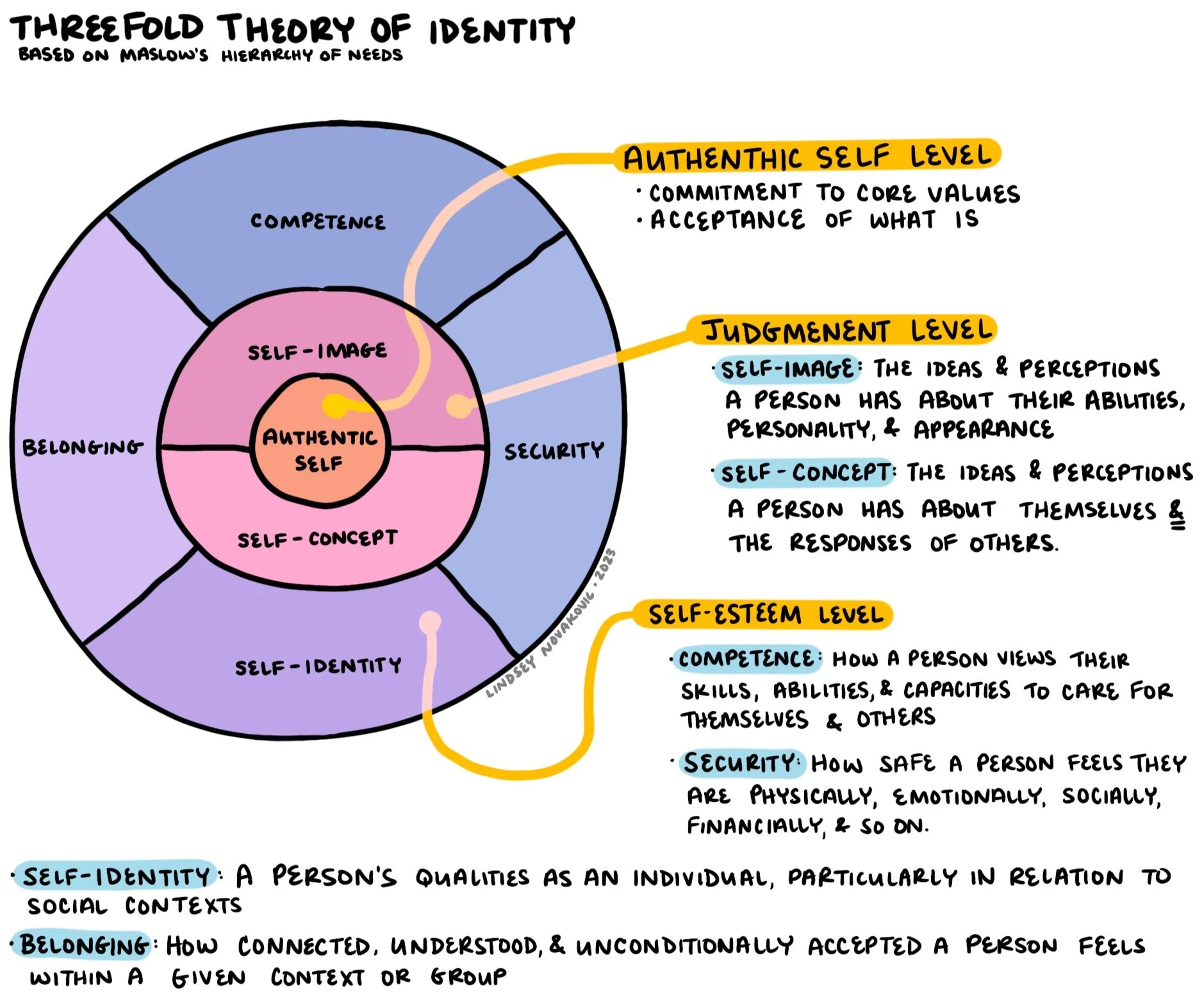
Image description: A diagram of the Threefold Theory of Identity. The outer layer of the circle has 4 pieces labeled “competence”, “security”, “self-identity”, and “belonging”, in shades of purple. The intermediate layer is divided into two parts labeled “self-image” and “self-concept”. The innermost piece of the circle is the “authentic self” in orange. The layers are labeled to the right of the diagram describing each aspect.
At the level of judgment, two factors feed each other. A person’s self-image is the ideas and perceptions a person has about their abilities, personality, and appearance. A person’s self-concept incorporates the responses of others with their self-image (Livneh & Antonak, 2018).
The innermost level is our authentic self, which is based on a commitment to a person’s core values and their acceptance of what is.
Our overall identity, then, is the amalgamation of our values, qualities of character, perceptions of ourselves, our abilities, and our place in the world, as well as others' perceptions of us. It stands to reason that if we feel strong in our sense of who we are and our connectedness with the world around us, we feel a greater sense of worthiness, and generally, our intimate relationships will thrive as a result. If, however, we feel less strong in our sense of self or don’t feel as if we belong, our sense of worthiness is typically weaker and we feel challenged in forming intimate relationships or our intimate relationships tend to struggle.
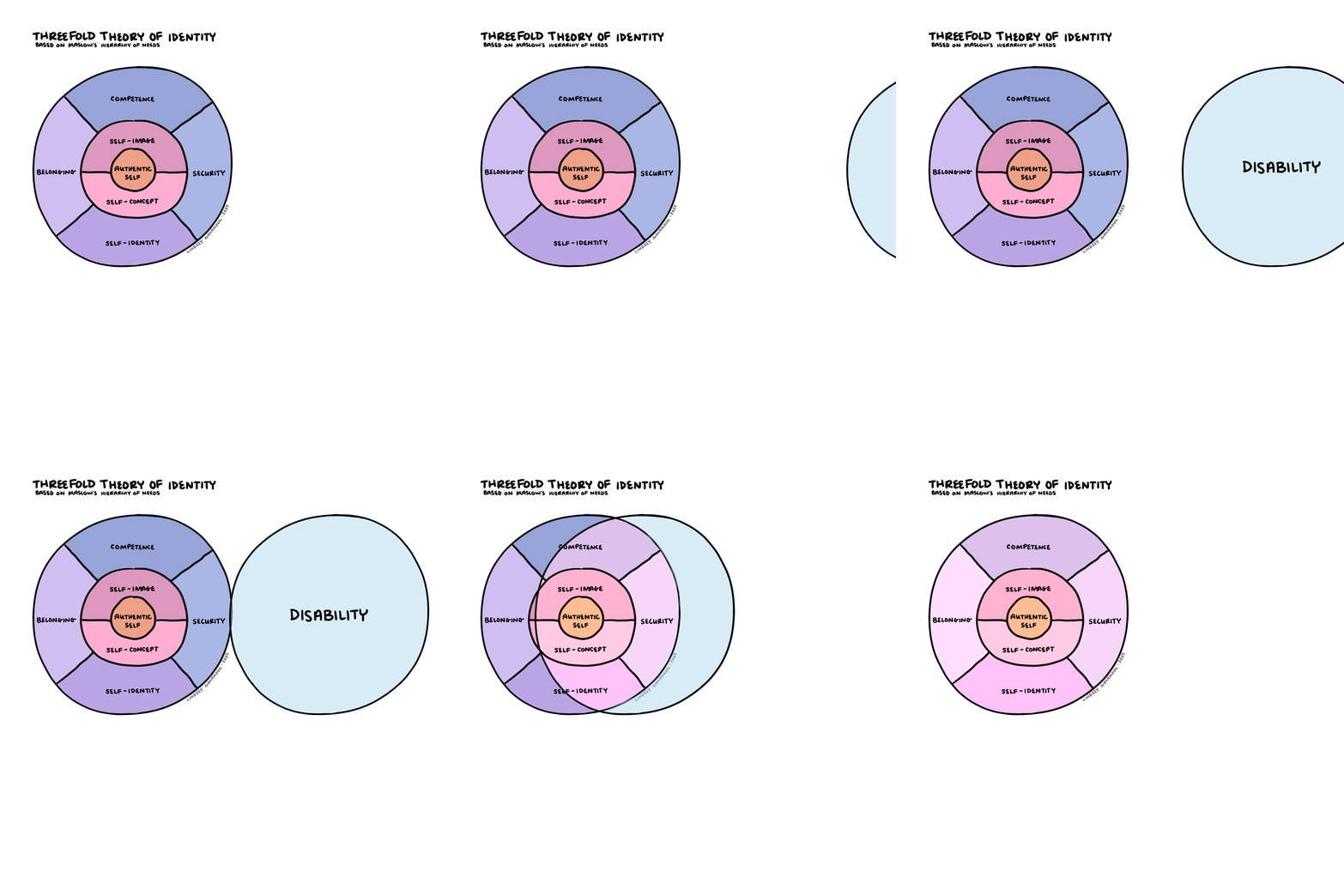
Image description: An animated gif depicting a blue circle labeled “disability” moving over the diagram of the Threefold Theory of Identity.
Disability
As people with disabilities, we can choose to identify with the disability identity (Kaufman et al., 2003). The experience of being congenitally disabled, disabled from childhood or adolescence, or having acquired a disability later in life can also impact how a person decides to—or not to—identify as a disabled person. For example, a person who acquired a disability later in their life may find accepting the disability identity more challenging as they might experience a “split” in themselves—between their body and what they’ve lost (e.g., the ability to participate in a hobby the way they enjoyed), whereas someone who grew up with a disability may not experience this “split” as they may not have experienced those losses in the same way or experienced them at all. However, they both may choose to identify as disabled people because this identity provides them with a sense of self and belonging (Rembis, 2018). In relation to TTI, this can be viewed as a lens changing the hue of the identity wheel.
Sexuality
Identities related to sexuality can also impact one’s self-image, self-esteem, and desirability. Sexuality refers to the multidimensional and dynamic characteristics of ourselves that encapsulate our sexual orientation, identities, gender roles, expression, and more (Ellis & Uncgo, 2023).
Click the (+) buttons to the right of the titles below to expand on Gender Identity and Sexual Orientation.
-
Agender: A person who identifies as not having a gender.
Cisgender: A person who identifies with the gender they were assigned at birth. A cis woman is a person who is born a female and identifies as a female. A cis man is a person who is born a male and identifies as a male.
Genderqueer (“queer”): A person who carries qualities of both the male and female genders or has unique qualities nonspecific to either gender. In some instances, this identity is related to or in response to the social construction of binary gender and its related stereotypes.
Gender fluid: A person who moves fluidly between the male and female gender over time or expresses multiple genders simultaneously.
Gender neutral: A person feels they are neither of the male or female gender.
Nonbinary: A person who does not identify as a man or woman, or with a gender at all.
Pangender: A person who expresses or encompasses multiple genders at once.
Third gender: A third gender that is neither male nor female or a combination of both genders.
Transgender: A person who identifies with a gender different than the one they were assigned at birth. A transwoman is a person who was born a male but identifies as a female. A transman is a person who was born a female but identifies as a man.
Two-spirit: Indigenous individuals may use this term to refer to an identity that describes a person who “walks between” genders. In other words, they either carry qualities of both the male and female gender or unique qualities nonspecific to either.
(Teen Talk, n.d.)
-
Allosexual: A person who is sexually attracted to others; some refer to this as the opposite of asexual.
Allotroposexual: A term used in place of the former “skoliosexual”; A person who is sexually attracted to transgender and/or non-binary individuals. This does not refer to the sexualization, objectification, or fetishization of transgender or nonbinary people. Another term used is “ceterosexual”.
Androsexual: A person who is sexually attracted to masculinity (e.g., expression, presentation, characteristics) regardless of the person’s sex or gender.
Asexual (Aces): People with little-to-no sexual attraction to others or desire for sexual contact. Many asexual people still have successful relationships regardless of sexual contact. It is helpful to view asexuality as a spectrum. A Libidoist Asexual is an asexual person who experiences sexual feelings and uses self-stimulation or masturbation as a means of satisfaction. As before, asexual people are not devoid of sexual feelings, however, they may find self-pleasure more enjoyable than sexual encounters with others.
Bicurious: A person who has historically been sexually attracted to people of the opposite sex, but has been considering or has curiosity about engagement in sexual activity with another of the same sex.
Bisexual: A person who is sexually attracted to both men and women.
Demisexual: A person who is sexually attracted to someone only after building an emotional connection with them.
Gay: A man who is sexually attracted to other men; this includes transgender men who are attracted to other men whether cisgender, transgender, or non-binary.
Gynosexual: A person who is sexually attracted to femininity (e.g., expression, presentation, characteristics) regardless of the person’s sex or gender.
Heterosexual: A person who is sexually attracted to another of the opposite sex.
Lesbian: A woman who is sexually attracted to other women; this includes transgender women who are attracted to other women whether cisgender, transgender, or non-binary.
Multisexual: A person who is sexually attracted to multiple gender identities or sexes.
Omnisexual: A person who is sexually attracted to all people regardless of sex or gender identity.
Pansexual: A person who is sexually attracted to people regardless of their sex or gender identity.
Polysexual: A person who is sexually attracted to multiple gender identities or sexes. Another term used is “multisexual”.
Sapiosexual: A person who is sexually attracted to people based on their intelligence.
(Bartel, 2022)
Click here to jump to the top of the “Sexuality” section.
Sakellariou (2006) proposes that disability can be viewed as the agent by which a person learns about and explores their sexuality through a fluid perspective. Tremain (2000) adds that by providing such a space for disabled queerism, we can begin to dismantle the heteronormative gender role and stereotypes that can become barriers to fulfilling intimate and sexual relationships (Tremain, 2000).
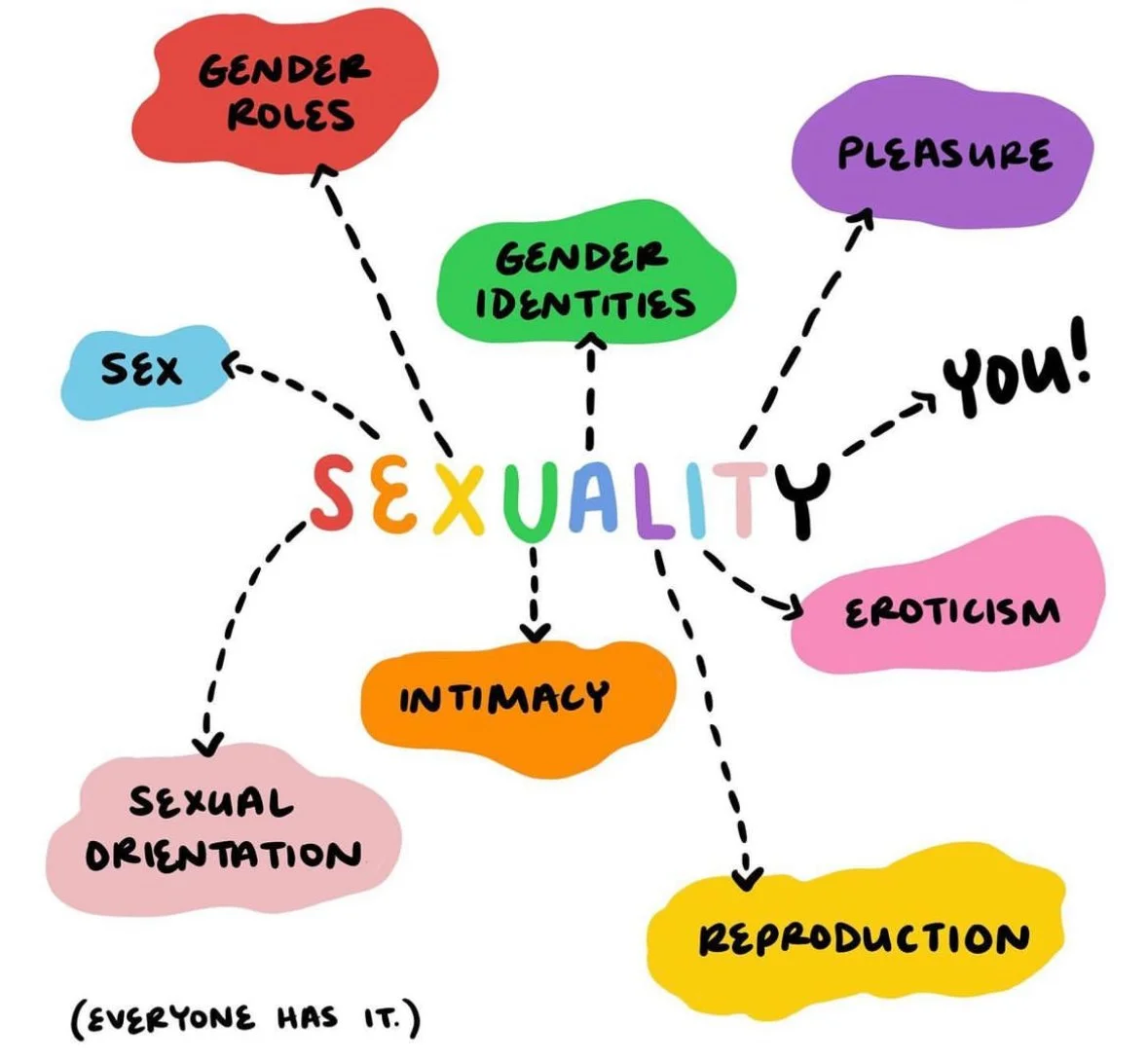
Image description: A brain map depicting the aspects of sexuality including sex, gender roles, gender identities, pleasure, eroticism, reproduction, intimacy, and sexual orientation. Sexuality also includes the self and self expression.
Implications
Much of the current research—which is scarce—remains focused on heteronormative and/or ableist narratives of disability and sexuality. There is a grave need for disability sexuality research that does not focus solely on the physical capacity of disabled people to perform sexually within their heteronormative gender roles.
Some important notes about language about sexual orientation
The term “homosexual” is now considered an inappropriate term to use about people who are sexually attracted to others of the same gender identity. It is also inappropriate to use the term “skoliosexual” as this term has been used for the sexualization, objectification, and fetishization of trans people by cisgender individuals (Bartel, 2022).
References
Bartel, J. (2022, December 30). A guide to 25 different types of sexualities. Retrieved August 29, 2023, https://www.choosingtherapy.com/types-of-sexuality/
Kaufman, M., Silverberg, C., & Odette, F. (2003). The ultimate guide to sex and disability: For all of us who live with disabilities, chronic pain & illness. Cleis Press.
Livneh, H. & Antonak, R. (2018). Psychological adaptation to chronic illness and disability: A primer for counselors. In I. Marini & M. A. Stebnicki (Eds.). The psychosocial impact of illness and disability (7th ed., pp. 77-90). Springer Publishing Company, LLC.
Maslow, A. H. (1943). A theory of human motivation. Psychological Review, 50(4) 370-396. https://doi.org/10.1037/h0054346
Rembis, M. A. (2018). Beyond the binary: Rethinking the social model of disabled sexuality. In I. Marini & M. A. Stebnicki (Eds.). The psychosocial impact of illness and disability (7th ed., pp. 141-150). Springer Publishing Company, LLC.
Teen Talk. (n.d.). Gender identity. Retrieved August 29, 2023, https://teentalk.ca/learn-about/gender-identity
Tremain, S. (2000). Queering disabled sexuality studies. Sexuality and Disability, 18(4), 291-299.